
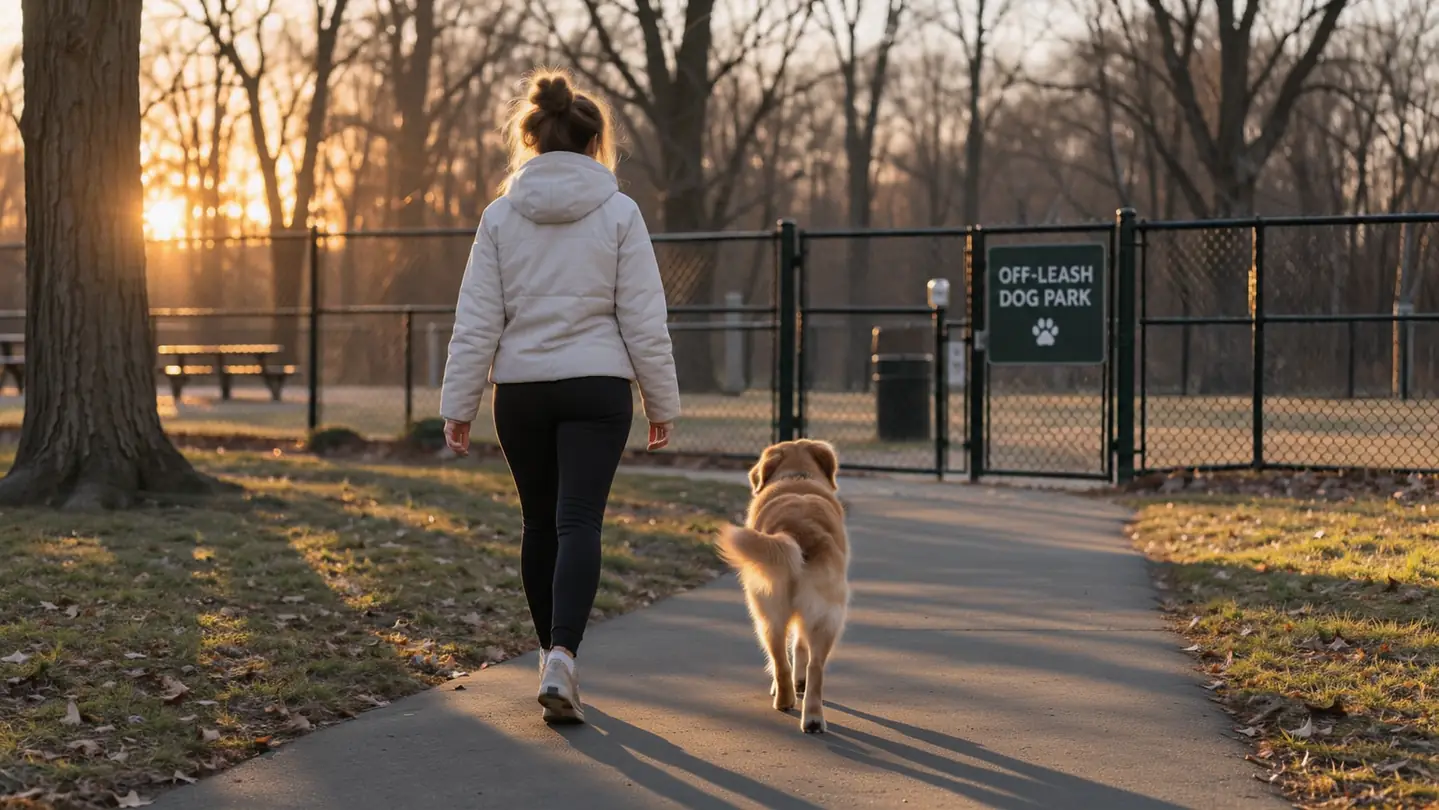
I have made the walk from the Forester to that park gate close to a thousand times, and for most of those trips I was doing three jobs with two hands. One hand on the leash. The other working the latch, or holding the water bottle, or digging a bag out of a coat pocket while Maisie leaned into her collar. She is a 6-year-old Australian Shepherd mix, about 48 pounds, and she spots the fence line from the far end of the parking lot. Something in that ten minutes had to change, because the hour inside the park was never the hard part. The hard part was getting there without dropping something.
About a year ago I started using the iYoShop hands free dog leash for the in-between pieces of the trip. The parking lot. The path. The gate. Not the fetch and not the water break, just the walking. It sounds like a small adjustment, the kind of thing you see at the park and shrug at. It gave me back a hand on both ends of every visit, and after a winter of muddy Saturdays I would not go back to a loop around my wrist.
Both hands back for the ten minutes that actually matter
The iYoShop hands free leash clips at the waist, keeps keys and phone in a zipper pouch, and gives you two extra handles for the parking lot and the gate. One year warranty.
Amazon Check Today's Price on Amazon →Step 1: Fit the Waist Belt in Your Kitchen, Not in the Parking Lot
Do this at home, on a morning when you are not already running late. Put on the coat you actually wear to the park, because a belt fitted over a t-shirt will sit differently over a winter jacket, and you will spend every cold morning tugging at it with one hand. The iYoShop waist belt adjusts from 27 inches at the smallest to 48 inches at the largest, and it closes with a buckle, so you can set it once and step into it from then on. Aim for the belt to sit on your hip bones rather than up at your natural waist. Hips do not change shape when you bend over to pick up a bag, and hips are the strongest thing you have to pull against.
The leash itself is 68 inches long and about an inch wide, and the whole thing weighs 9.6 ounces. That is light enough that once the belt is on, it stops being something you are carrying and becomes something you are wearing. Check the clip before you leave the house the first few times. It is a 2 inch heavy duty clip, and it should open and shut with a firm snap, not a wiggle. A clip that wiggles is a clip that will let go at the worst possible moment, which at our park is always the moment a Labradoodle comes through the gate.
Then walk the driveway with it. Put Maisie on, put your hands in your pockets, and go up and back a few times on purpose. You want to feel the belt stay put when she leans, and you want to find the spot where it does not rub. Two minutes in the driveway on a Tuesday saves you from adjusting a buckle one-handed in a crowded lot on a Saturday. If it slides, tighten it a notch and try again. It should feel snug enough that you notice it for the first five minutes and then forget it entirely.
Step 2: Load the Zipper Pouch and Put the D-Ring to Work
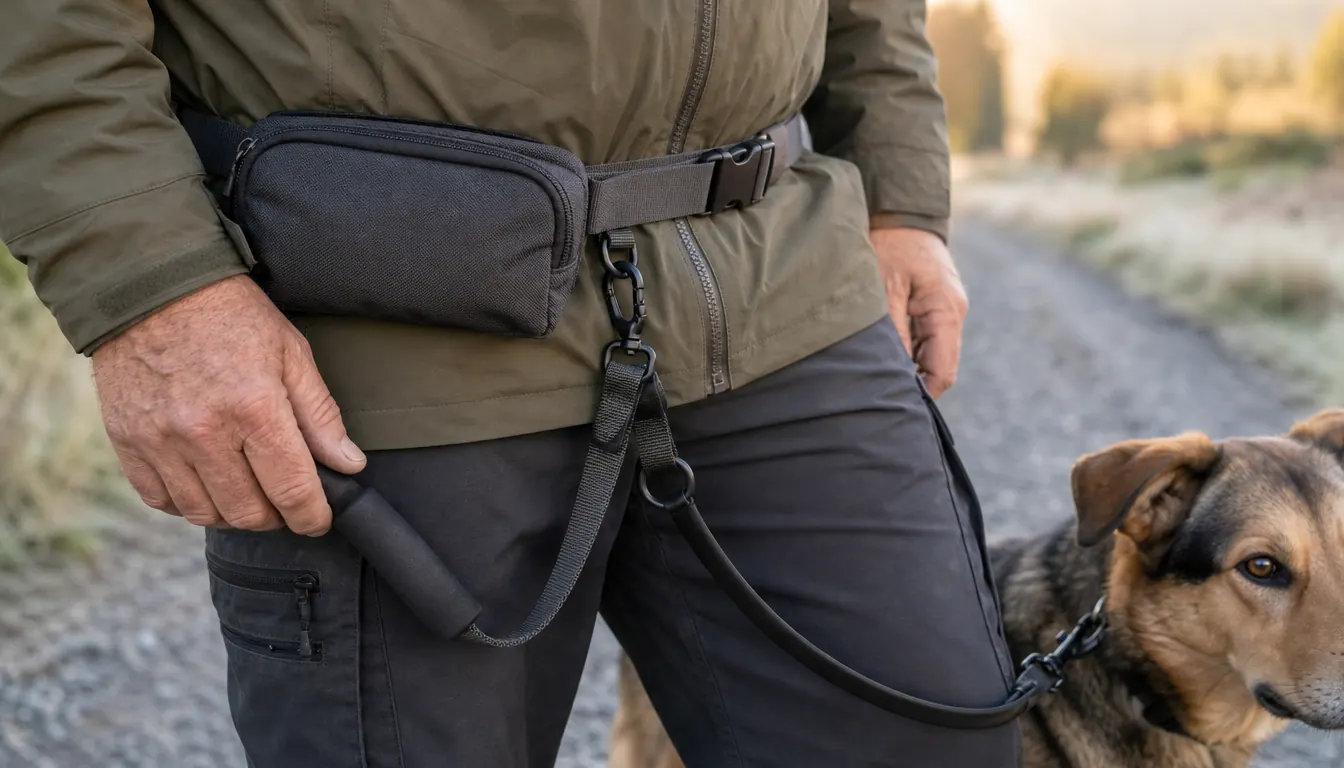
The zipper pouch on the belt is the piece I did not expect to care about and now use every single day. Keys, phone, and a folded spare bag go in it. That is the whole list. It is not a backpack and it will not hold a full water bottle comfortably, so do not try to make it one. The point is that your pockets stay empty and your hands stay free, and a phone that is zipped into a pouch at your hip does not end up face down in the mud when somebody's young dog comes barreling past at full speed.
There is a D-ring on the leash, and this is where the Earth Rated bag holder earns its keep. I clip the dispenser there, which keeps the roll off the handle and out of the way when I need to grab the leash quickly. Before I did this I was the person patting down three coat pockets at the worst possible moment, muttering to myself, while Maisie pulled toward the fence. Now the bags live in one spot and the dispenser swings with the leash instead of with my arm.
One more thing about the pouch. Zippers get grit in them at a dog park, and grit in a zipper is how a zipper stops being a zipper. Rinse the whole belt off in the sink every couple of weeks, work the zip open and shut a few times while it is wet, and let it hang dry. I learned that lesson with a winter coat, not with this leash, and I would rather you learn it from me than from a stuck zipper in a parking lot in February.
Step 3: Use the Lower Handle for the Parking Lot Walk
The iYoShop leash comes with two extra handles beyond the one at the end. One is the waist handle at the belt, and the other sits down near the clip. That lower one is the handle you will use most, and it is the one that makes this work. The parking lot is the busiest, least predictable part of the whole trip: car doors opening, a loose dog by somebody's bumper, a person who wants to tell you about their granddog while your dog is dancing at the end of the line. Grip that lower handle and Maisie stays at your side where you can steer her instead of skiing behind her.
This is also where the two shock absorbers do their quiet work. Maisie does a small lunge when she sees a familiar dog across the lot, and the leash gives a little before it goes tight. It is not a training tool and it will not teach her not to pull. What it does is take the snap out of the moment, so that a 48 pound dog leaning forward does not yank your shoulder on the way to the gate. I feel it most on the mornings when the lot is full and we are walking between parked cars where I cannot give her much room.
When the lot is clear and you are on the path, let the leash out to its full length and let her trot ahead. The belt takes the pull across your hips instead of your wrist, which matters more every year. I noticed it on the mornings when I used to arrive at the gate already annoyed, holding the loop with one hand and the bottle with the other, shoulders up around my ears like I was bracing for something. Ten minutes of that sets the tone for the whole hour.
One belt, one clip, both hands back. I have not chased a water bottle across that parking lot since last spring.
Step 4: Keep Both Hands Free at the Gate
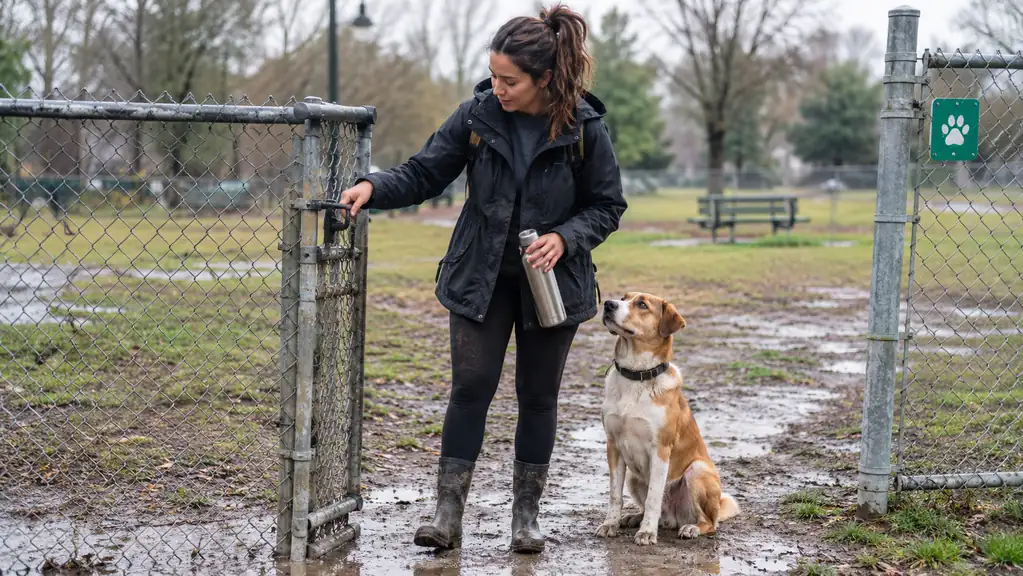
The gate is the whole reason I bought this thing. Ours is a chain latch that needs a real lift and a swing, and it is the kind that will not open if a dog is leaning into it. With the leash around my waist, I can use both hands: one to lift the latch, one to push the gate open. Then I step through and hold it with a hip while Maisie goes ahead. No leash wrapped around a wrist. No bottle tucked under my chin. No bag pinched between two fingers while I try to be graceful about it.
Once you are inside, the pouch handles the rest. I pull the water bottle out of the side pocket of my park bag and I have a hand free to hold it while I fill the little trough. On Saturdays, when my grandkids come along, that free hand is even more useful. One hand for the gate, one hand for a kid, and Maisie on the belt where I can feel her through the pull instead of having to watch her with my eyes every second.
Do not unclip at the gate. Unclip inside the fence, in the double gate area if your park has one, and not a second before. This is not about the leash being a restraint. It is about that particular moment, when a dozen dogs are moving and your dog is excited and the gate is swinging behind you, being the worst possible one to be doing anything one-handed. Get through, get clear, then reach down and let her go.
Step 5: Clip On Before You Leave the Fence and Walk Out Calm
Leaving is harder than arriving and nobody warns you about it. A tired dog who does not want to go home will plant, and a wet dog will find a way to press against your leg. Clip the leash on while you are still inside the fence and let her settle for a few seconds before you move. Then walk out at your normal pace with your hand on the lower handle. A firm, boring exit teaches a dog more than a long one, and it keeps you from being the person dragged sideways through a gate at 8:45 in the morning while everybody else watches.
Out in the lot, drop back to the waist and let the full length out. The walk back to the car is when I finally check my phone, and the pouch means I am not doing that with a leash pinched in my elbow. Keys come out of the zip, the back gate of the Forester goes up, and Maisie is at the bumper with a hand on the handle and nothing tangled around anybody's legs. It is a small, unremarkable piece of choreography that took me years to get right.
Then the ride home, which is the hammock's job and not the leash's. I unclip at the car, she hops into the back seat, and the belt comes off and hangs on the hook by the garage door. One year in, the belt still looks like a belt, the clip still snaps, and the pouch zipper still runs. It carries a one year warranty and I have not had to use it. That is not a dramatic review. It is exactly the review you want for something you touch twice a day in all weather.
What Else Helps
The leash solves the walking. It does not solve everything else, and it is worth being clear about that up front. The water is the Kalimdor bottle in the side pocket of my bag, filled at the kitchen sink before we leave, because Maisie had an upset stomach two years ago after drinking from the shared park bowl and I have not used that bowl since. The fetch is the Chuckit! Classic launcher that rides in the back of the Forester with three balls, and it saves my right shoulder on days when I throw for twenty minutes straight.
The cleanup is the Earth Rated holder clipped to the D-ring. The ride home is the Active Pets hammock in the back seat, installed three years ago after the morning Maisie came back from a rainy park visit soaked through and I spent a Saturday scrubbing mud out of upholstery. Each of those does one job and none of them does another's. A hands free leash does not carry water and it does not clean a car. What it does is put both of your hands back for the ten minutes on either side of the gate, which happens to be the part of the trip where you need them.
If you have been looping a leash around your wrist for years, the change is not dramatic and it is not instant. The first week you will still reach for the handle out of habit. By the second week you will be lifting the latch with one hand and holding a bottle in the other without thinking about it, and by March you will wonder how you ever did the muddy version. Start with the belt, walk the driveway, and take it to the gate on a quiet morning before you try it on a Saturday.
Start with the ten minutes around the gate
Adjustable waist belt from 27 to 48 inches, two extra handles, a zipper pouch for keys and phone, and a 2 inch clip. Sized for dogs 25 to 120 lbs.
Amazon Check Today's Price on Amazon →