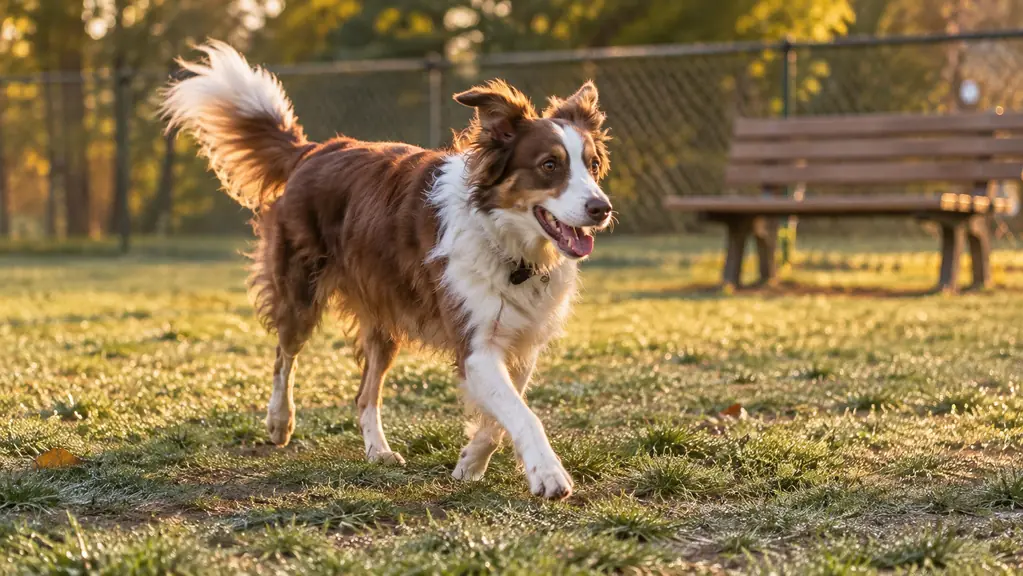
Seven thirty in the morning at the fenced off-leash park ten minutes from my house, and Maisie has already made three laps of the perimeter. She is six years old, an Australian Shepherd mix, about 48 pounds, and she runs like the grass is on fire. Around eight she comes back to check on me, stands in front of the bench, and stares at my bag. Not at me. At the bag. She learned that look about two years ago, which is when the Kalimdor dog water bottle moved into the side pocket and stopped being something I only sometimes remembered.
Before that I was the woman with a plastic bottle and a cupped hand, pouring half of it on the ground and the other half down my own wrist. On the mornings I forgot altogether, Maisie drank out of the shared bowl by the gate, the one everybody tops up, and that night she had an upset stomach that kept us both awake. One bad night was enough. A bottle that holds water and lets a dog drink without a bowl, without my hand, and without a puddle is not a complicated idea, and that is exactly why the Kalimdor version of it works. What follows is the whole routine, the way I actually do it, not the way I would do it if I were more organized than I am.
Fill it once at the sink and stop hunting for a bowl at the gate
19 fluid ounces of water, one hand to hold it, no bowl to rinse and no shared bowl to worry about. It lives in my park bag now.
Amazon Check Today's Price on Amazon →Step 1: Fill It at the Kitchen Sink, Not at the Park
The bottle holds 19 fluid ounces, a little more than two standard cups, and it measures 2.7 inches by 2.7 inches by 10.2 inches and weighs about 8.47 ounces when it is empty. That is light enough that I forget it is in the side pocket of the park bag, and tall enough that it does not vanish to the bottom the way a collapsible bowl does. For an hour at the park with one 48-pound dog, 19 ounces has been enough every single morning, including August.
Why at home and not at the park? Because the park spigot is a line of three dogs and a woman holding a bowl with her knee, and because the water comes out warm in July. Filling at the sink takes about fifteen seconds and it is the only part of this routine that can go wrong. Everything after it is just carrying a bottle.
I fill it while the coffee is going. Bag on the counter, bottle under the tap, cap closed, bottle back in the pocket, and then I do not think about it again until Maisie is staring at me under a tree. If I am honest, the step I forget is the fill, not the carry. Twice this spring I got to the park with an empty bottle in the bag and had to walk back to the car feeling foolish. The second time, I stood in the parking lot and watched a woman fill a collapsible bowl from a jug in her trunk, and I thought: that is a person who has also forgotten. Now there is an index card taped inside the door at dog height, written by one of my grandkids in fat blue marker, and it says WATER. It has worked for eleven straight mornings.
Step 2: Practice the Trough at Home Before You Need It
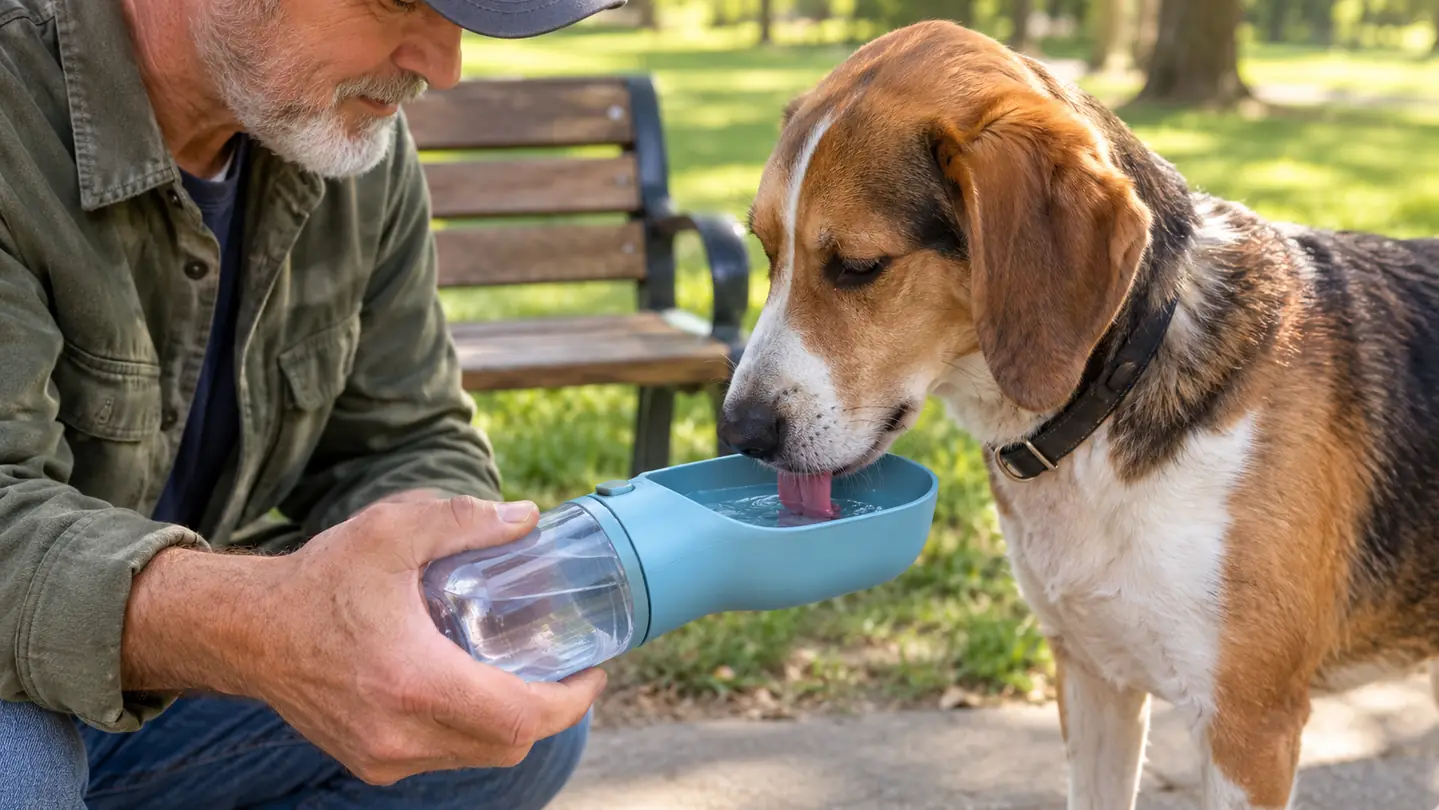
The drinking end of the bottle is a trough about 2.8 inches across, and a dog who has only ever drunk from a bowl may sniff it once and back away. Maisie did. She looked at it the way she looks at the vacuum cleaner. That is normal, and it is not a reason to give up on the bottle, it is a reason to spend five minutes in your own kitchen before you try it in public.
Do it on a quiet afternoon with no audience. Hold the bottle low and still, let the dog sniff the trough, let a little water settle into it, and wait. Do not push it toward the dog's face and do not tip it up like a baby bottle. Two or three tries over a couple of days and it stops being an object and starts being the water thing. I did this in my kitchen in about the time it takes to boil pasta.
The other reason to practice is that a dog who has never seen the trough will knock it with a nose at the park, and you will spill 19 ounces onto your own shoes in front of the regulars. Ask me how I know. It was a Tuesday in April, I had just filled it, and a friendly labrador I had never met came over to investigate while Maisie was drinking. The trough went sideways and most of the water went down my left pant leg. Nobody was unkind about it. Everybody laughed, including me, and then I walked back to the car for the spare bottle I now keep in the console of the Forester.
Step 3: Offer Water Before the Dog Is Desperate
The mistake I made for the first year was waiting until Maisie looked wrecked, then trying to get her to stand still and drink. By that point she wanted shade and a lie-down, not a beverage. Now I offer at the check-in. She runs, she comes back to touch base, and while she is standing there catching her breath I hold out the bottle. She takes five or six laps and goes back to work. That happens two or three times across the hour.
What I watch for is the change in the run itself. The mouth opens wider and stays open. The tongue hangs low. She starts taking the long way around the other dogs instead of through them, and she drifts toward the bench instead of the middle of the field. That is my cue, whether or not she asks. I am not a vet and none of that is a diagnosis. It is just what a dog looks like when the tank is getting low.
Small amounts, offered often, beats one long drink at the end. I let her take a few laps, lift the bottle, and let her walk away. Ten minutes later she comes back and we do it again. She drinks more across the hour this way than she ever did when I poured a puddle into my hand and hoped for the best. On Saturdays my grandkids ride along, and they have appointed themselves water monitors. One of them holds the Kalimdor bottle while I hold the leash, and the dog drinks better for a child than she ever does for me, which is a fact I have decided not to take personally. The only rule is that the bottle stays level, and a child can manage that if you tell them twice.
The bottle is not the hard part. The hard part is filling it at seven in the morning while the dog is already spinning by the door, and that is the one step I still forget about once a month.
Step 4: Hold It Steady and Let the Dog Set the Pace
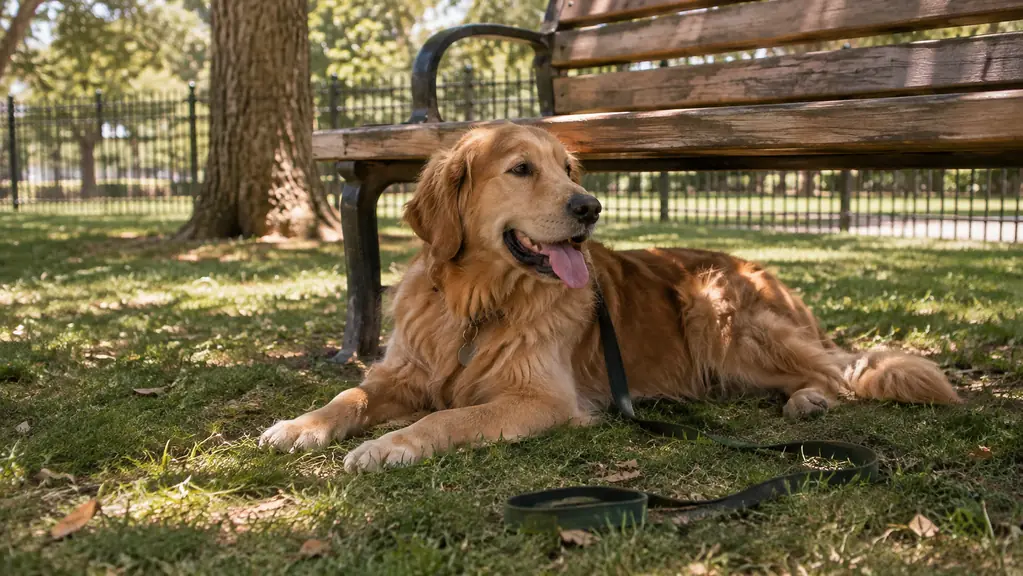
Hold the bottle at the height where your dog stands naturally, with the trough level. Not up high, not tilted down into the dog's face. A steady hand is the whole technique. Maisie will take four laps, pause, look at the field, and then take two more, and if I move the bottle during that pause she loses interest entirely. I stand still, breathe, and let her drive.
At a busy park you will get company. Another dog will come over to see what the first dog has, which is why I step to the side of the field, near the bench or against the fence, and do it there instead of in the middle of a chase. One dog at a time. The trough is small and it is not a public fountain, and the owners I know feel the same way I do about the shared bowl by the gate.
On hot mornings we do it more often, maybe four times instead of two, and I pour out whatever is left and refill before the next trip rather than carrying yesterday's warm water around. In February the same bottle comes out twice and that is plenty. There is one more thing I check in the summer, which is that the water inside is water I would drink myself. The listing calls the plastic food grade, and after two years of daily use the inside still smells like nothing, which is the only test I know how to run on a plastic bottle. A jug that has gone sour is a smell you cannot rinse out, and I have thrown away more than one of those in my life.
Step 5: Close It, Bag It, and Rinse It When You Get Home
When the dog is done, close the bottle and put it straight back in the side pocket. Not loose in the main compartment next to a wet tennis ball and a bag of treats. The point of a leak proof bottle is that it does not need its own zip bag, and two years of mornings has not given me a reason to argue with that.
At home, empty whatever is left, rinse the trough and the inside with fresh water, and set it on the counter to dry. Once a week it gets a proper wash with warm water and a bottle brush, the same as any water container in the house. I do not leave water sitting in it in a hot car, and I do not leave it in the bag from one week to the next. I learned that in a July when I left it in the Forester overnight after a Saturday trip with the grandkids. The water that came out the next morning was warm and flat, and Maisie turned her nose up at it, and she is a dog who eats grass.
Then it goes back in the bag by the door, empty, waiting for the next fill. That is the habit that stuck. The bottle lives in the park bag and the park bag lives by the door, so the only thing standing between Maisie and a drink is fifteen seconds at the kitchen sink.
What Else Helps
Four other things come to the park with us every morning, and each one does exactly one job. The water is the Kalimdor bottle. Fetch is the Chuckit! Classic launcher, which I have had for about four years, and which saved my right shoulder after a friend handed hers over one morning and I ordered my own that afternoon. Cleanup is the Earth Rated holder on the leash handle, used for about three years now, refilled from the box of rolls in the hall closet. Walking in from the parking lot is the iYoShop hands-free leash, the newest item at about a year old, which keeps both hands free for the gate latch, the launcher and the bottle.
The ride home is the Active Pets hammock in the back seat of the Forester, installed for about three years now, since the morning Maisie came back from a rainy visit soaked in mud and I spent an hour with a towel and a bad attitude. It stays in the car and gets hosed off about once a month.
None of these items does another one's job, which is the only reason my bag stays light. If you are starting from nothing, start with the water. A thirsty dog cuts a park visit short faster than anything else, and a bottle is the simplest way to keep an hour from turning into twenty minutes. The launcher and the bag holder can wait for a birthday.
Nineteen ounces that keep the hour from ending early
Two years in the side pocket of my park bag, filled at the kitchen sink every morning. 19 ounces is enough for one dog and one visit.
Amazon See the Kalimdor Bottle on Amazon →